Poles mourn rare mass killing as authorities say attacker had far-right views
Evelyn graduated from Bard College with a degree in Art History. She has spent the past three years covering local art events and cultural happenings for Rochester City Newspaper, bringing a unique perspective to the city’s vibrant arts scene.
More from Evelyn →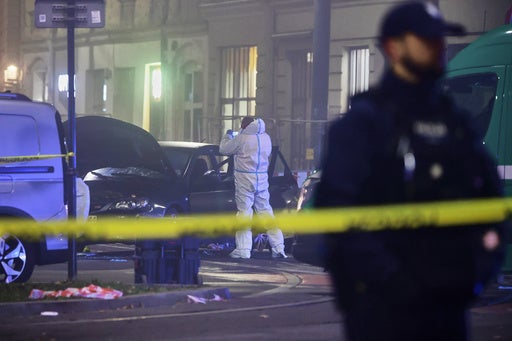
In this story
The air in Krakow’s Main Square, usually vibrant with the laughter of tourists and the chime of St. Mary’s Basilica, now hangs heavy with grief. It was here, just days ago, that a young man’s act of unimaginable violence shattered the tranquility of this historic city, leaving six dead and fifteen wounded. The chilling details – a car deliberately driven into the square, a barrage of gunfire, and the subsequent discovery of a family slain in their Ostrowiec Świętokrzyski home – have plunged Poland into a period of national mourning. The abrupt silencing of St. Mary’s Trumpet Call, a tradition unbroken since World War II, serves as a poignant and heartbreaking symbol of the nation’s collective sorrow. St. Mary’s Basilica, a landmark of Krakow, stands as a silent witness to the tragedy.
The Attack and Its Aftermath
On Saturday, November 7, 2026, a 24-year-old man with far-right views drove a vehicle into Krakow’s Main Square and opened fire on unsuspecting pedestrians. The attack resulted in the deaths of six people and injuries to fifteen others. The Main Square, a major tourist hub and the heart of Krakow’s Old Town, was immediately closed, and mourners began leaving candles in remembrance of the victims. The incident has been described as an “act of terror” by Poland’s defense minister. By Saturday evening, mourners had left candles in memory of the victims. The square remained partially closed on Sunday as authorities continued their investigation. On Sunday afternoon, St. Anne’s Church in Krakow filled with mourners attending a memorial service for the victims of the tragedy.
The suspect, whose name has not been released, had held gun permits alongside his father. Authorities have recovered a total of 11 weapons from both the suspect’s car and his family home in Ostrowiec Świętokrzyski, approximately 93 miles northeast of Krakow. The Swit shooting club in Starachowice, where the suspect is believed to have trained, stated that he received only “static shooting” training, not tactical or combat training. The investigation has revealed that the suspect held “very radical” and “ultranationalistic” views, according to Interior Minister Marcin Kierwiński. The suspect remains in critical condition after undergoing multiple surgeries, while the two police officers who stopped him are hospitalized but conscious. The Polish Police are leading the investigation.
Victims and Witnesses
Among the victims were four women and two men. Three of the women and one of the men were Polish, while a man from the United Kingdom and a woman from Austria also perished in the attack. Five foreigners, including residents of the U.K., Portugal, Russia, Germany, and Austria, were among the wounded. Marie-Ange Collaer, a tourist from Brussels, recounted the terror of hiding from bullets in a shop, describing the experience as feeling “like in a bad police movie.” Neil Thaxton, a U.K. resident, shared a similar account of seeking refuge with shop staff after hearing gunshots. Alexandros Maronitis, a tourist from Greece, expressed fear after being unable to return to his lodgings for five hours. American tourist Marylin Green, whose parents were Polish immigrants, lamented the loss of innocence in what she had hoped would be a joyful visit to Poland. Witness Andy Hill described the scene as feeling unreal and recounted the instinct to seek immediate shelter.
The Suspect’s Family
Tragically, authorities later discovered the bodies of the man’s mother, father, and sister at his family home in Ostrowiec Świętokrzyski. They likely died from gunshot wounds. Magdalena Oksińska, the suspect’s sister, was a third-year student at the Krakow Academy of Fine Arts, described by her colleagues as an “absolutely talented painter, photographer, poet and writer.” Her death has deeply impacted the artistic community. The Krakow Academy of Fine Arts released a statement mourning her loss, noting that “Nothing will ever be like before. The delicate tissue of our academic community was painfully wounded.” Architect Pavko Krajka posted images of the artist’s colorful paintings on social media, describing her as a “queer person” and a great loss to Krakow, Polish, European and queer culture.
Heroic Actions and Medical Intervention
Local heroes emerged during the chaos. Michał Pędziwiatr and Mateusz Wierdak, two local surgeons, rushed to help a wounded police officer, saving his life. Pędziwiatr described Wierdak’s quick actions in stopping the bleeding as “probably [saving] his life,” noting that he “took care of the officer who subdued the attacker because he truly needed urgent help, without protection, without gloves, he simply focused on the officer.” Police officers also stepped in, with one described as a hero for repeatedly shooting the attacker until he collapsed. The two officers who stopped the gunman are in critical condition but conscious.
The Broader Context
The attack marks a grim first for Poland. Interior Minister Marcin Kierwiński said the suspect holds “very radical” and “ultranationalistic” views and that “everything indicates that he was fascinated by far-right ideologies.” Around 411,000 people hold gun permits in Poland, which has a population of 37 million, and interest in gun ownership has been rising. The incident follows a series of attacks in mid-October involving three attacks at schools in the central province of Mazovia within four days, leaving one person dead and many wounded, including children. Officials blamed the school attacks on online “glorification of violence,” and said that some of the attackers were active in the far-right environment.
Analysis and Future Concerns
Kacper Rekawek, a senior researcher at the International Center for Counterterrorism in The Hague, said the Krakow shooter’s military gear, guns and overall look were similar to those of other “extreme right lone actors” committing attacks around Europe. He stated that, “We have had attempts before, but now we can say that these kinds of attacks have become successful in Poland.” Prosecutors said Sunday they opened an investigation into the murder and attempted murder of numerous people, including police officers, with the act “constituting a terrorist offense.”
Evelyn's Take
What happened in Krakow is a stark reminder of the fragility of peace and the insidious nature of extremist ideologies. It’s heartbreaking to witness such violence shatter a city so steeped in history, beauty, and a deep appreciation for the arts. The fact that this tragedy occurred in a place as cherished as Krakow’s Main Square underscores the vulnerability of even the most idyllic settings. The deaths of the suspect’s family, while tragic, also raise unsettling questions about the potential for radicalization within families and the challenges of identifying and addressing these dangers early on. The swift and courageous actions of the police officers and the local surgeons are a testament to the inherent goodness and bravery that exists within communities, even in the face of unimaginable horror. It’s a time for families to hold each other close, to reaffirm the values of faith, community, and respect for human life – values that are so essential to building a stable and flourishing society. The rise in gun ownership in Poland is a complex issue that warrants careful consideration, alongside a renewed commitment to addressing the root causes of extremism and violence.
Resources and Support
For those seeking information or support following the Krakow tragedy, several resources are available. The City of Krakow’s website provides updates on the investigation and offers assistance to those affected. The Polish Ministry of Foreign Affairs offers consular assistance to foreign nationals. Mental health support and counseling services are available through local organizations and healthcare providers. The Polish Police have established a hotline for those with information related to the investigation, and encourage anyone with relevant details to come forward.
The events in Krakow leave a lasting scar on Poland and serve as a stark reminder of the importance of strong families, unwavering faith, and a commitment to upholding the values that define our communities. As Poland mourns, may we all find strength and resolve to build a future where such tragedies are never repeated.